Maeda, John. The Laws of Simplicity : Design, Technology, Business, Life. New York: MIT P, 2006.
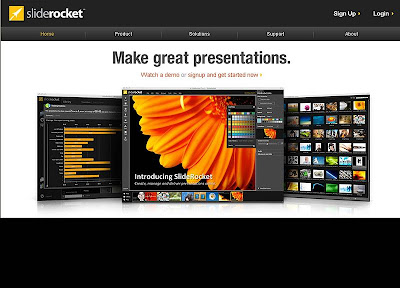
...if only it were Free! SlideRocket is a powerful new tool to edit, share and author digital presentations. The software includes smooth special effects that if used correctly can add to the storyline, not distract from the message. Since SlideRocket is an online application, the software makers claim to provide greater options to collaborate, link data and securely share presentations online. The software even differentiates its users into five clear needs: Unless you subscribe for this 'software as a service' model for $10 a month as an individual or $20 for an unlimited account business version, then you cannot download the special presentation player required to playback the presentation. A major downside.
SlideRocket's Comparison to Slideshare
Most people will not pay money for a software, which they feel PowerPoint can do an adequate job. First I would like to remind you that nearly all of us or our employer's have paid for PowerPoint too, only the payment was a one time charge for Microsoft Office. Unlike year or more product releases of PowerPoint, SlideRocket is continuously upgraded and made available. A key feature is that SlideRocket presentations are always accessible on the Internet, so if you can touch the cloud, you can grab the presentation regardless of location. We are all tired of trying to email 10MB PPT slide decks. For those willing to invest in the latest technology that has a chance of differentiating you from your peers, competitors and the ordinary, then SlideRocket may be the answer. Right now, I am still considering my options. But this application has me excited about the future of PC presentations.
References
Sliderocket
Author: Stephen Few Here are some notes I made from the book The Articulate Executive In Action by Granville N. Toogood. It is just a fraction of what the book talks about but it can help you when you are making a presentation.
CVA = Communications Value Added
What is it?
- That something extra you can give
- You are not afraid to show yourself
- Passionate. You are a true believer.
Example of a true believer:
“A man named David Orrick enthusiastically pitches his industrial strength cleaners on the radio and cleans up big time”
Who has CVA?
- Jezus
- Mohammed
- Gandhi
You know these people because of what they did, not because of their written words!
The Seven principles of CVA
1. Never bore
Be passionate, use anecdotes
2. Always leave people with more when they walk out than when they walked in
Give Value
3. Always be master of your presentation, not the other way
PPT should help your pitch, not be your pitch
4. Speak only about what you know
Stick to the roots
5. Always be sensitive to the needs of your audience
6. Speak in pictures
No abstract things. Give war stories or solid but simple evidence
7. Preparation
Know what you want to tell. Do your homework
-Bastiaan
A great method to get practical experience speaking in front of groups is to join a local Toastmasters club. Founded over 80 years ago in California, today Toastmasters International serves nearly 250K public speakers globally in over 90 countries. 
A Good Place to Start In 1984 a conference was founded in California to bring together top experts from Technology, Entertainment, and Design. In 2007, the conference dubbed ‘TED’ released over 200 presentations on the Internet to the public for free viewing or download to your desktop or iTunes. Each week new presentations are added, which feature some of the top global scientists, business experts and thinkers. In more recent times, TED implemented an 18 minute speech limit. Coincidentally a US Navy study found that 18 minutes is the optimal duration for an audience to absorb and remember what a speaker is saying. Websites like TED give you an advantage as a speaker. By reviewing subject matter experts in your field you can gain inspiration and knowledge in your presentation topic. In addition you can incorporate their insights into your presentations, add your own interpretation and analysis, and replicate your own ideas by creating a new ‘meme’. I encourage you to go to www.ted.com and watch presentations that interest you. As you learn new ideas, pay close attention to the speaker’s opening, ending and delivery style. Observe what works and what does not. If a speaker inspires you, ask yourself ‘why?’ While you internalize new speaking, delivery and presentation techniques, take care not to simply mimic or directly imitate. Instead study the most effective elements of each speech and personalize best practices. Think inspiration, not imitation. People are influenced by your words when emanated from the inner you. And remember to tailor your message not your personality relative to your audience. Case Example: In 2005, a Chinese VP, GM of Lenovo China asked me to deliver a presentation to Haas School of Business MBA students from UC Berkeley visiting Lenovo in Beijing. This request terrified me. Haas is one of the best business schools in the USA, and is located in my hometown – the San Francisco Bay Area. I knew my title and education were far below each audience member. I shakily delivered the presentation and quickly sat down. After the presentation my Chinese Executive boss instructed me, “Never show your fear. I know these guests hold higher titles, more experience, and better education than you. But you are the expert on Lenovo. You know our business better than they do. Focus on your message.” Next a Canadian employee at Lenovo told me some equally strong advice, “I do not know why you are intimidated by high-titled executives – they are just people too! You acted really stiff and serious in front of Haas. But that is not the Cory that people know. It seemed like a different person was up there. You should show your personality, your charm. He paused. People like that guy!” After this experience I confidently focus on my message and act like myself whether or not the audience is the UK Ambassador to China, Chairman of Ericsson or MIT’s Sloan School of Management.
If you are presenting to a group of CEOs, academics or the Press - regardless of your rank or position, avoid the temptation to act higher level than you actually are. Likewise never act insecure in the face of a prestigious audience. Your personality should remain naturally consistent across audiences. This will demonstrate your confidence and add texture to your core message. Focus on your key message, not on yourself. You will improve your chances for success if you provide value added analysis, take a position, and leverage your personality to endorse your message. Observe how speakers from all social backgrounds deliver confident presentations to highly elite audiences at the TED conference. Benchmark their performances and internalize their best practices!
- Cory, Guanghua Professor of Executive Level Presentations and Visual Communication; Photo Credit property of www.ted.com